What makes a brand stand out in a crowded marketplace? Is it the product, the price, or how consumers connect with its message? The answer often involves all three, along with where the product is sold. These elements make up the marketing mix, commonly known as the 4 Ps: product, price, place, and promotion.
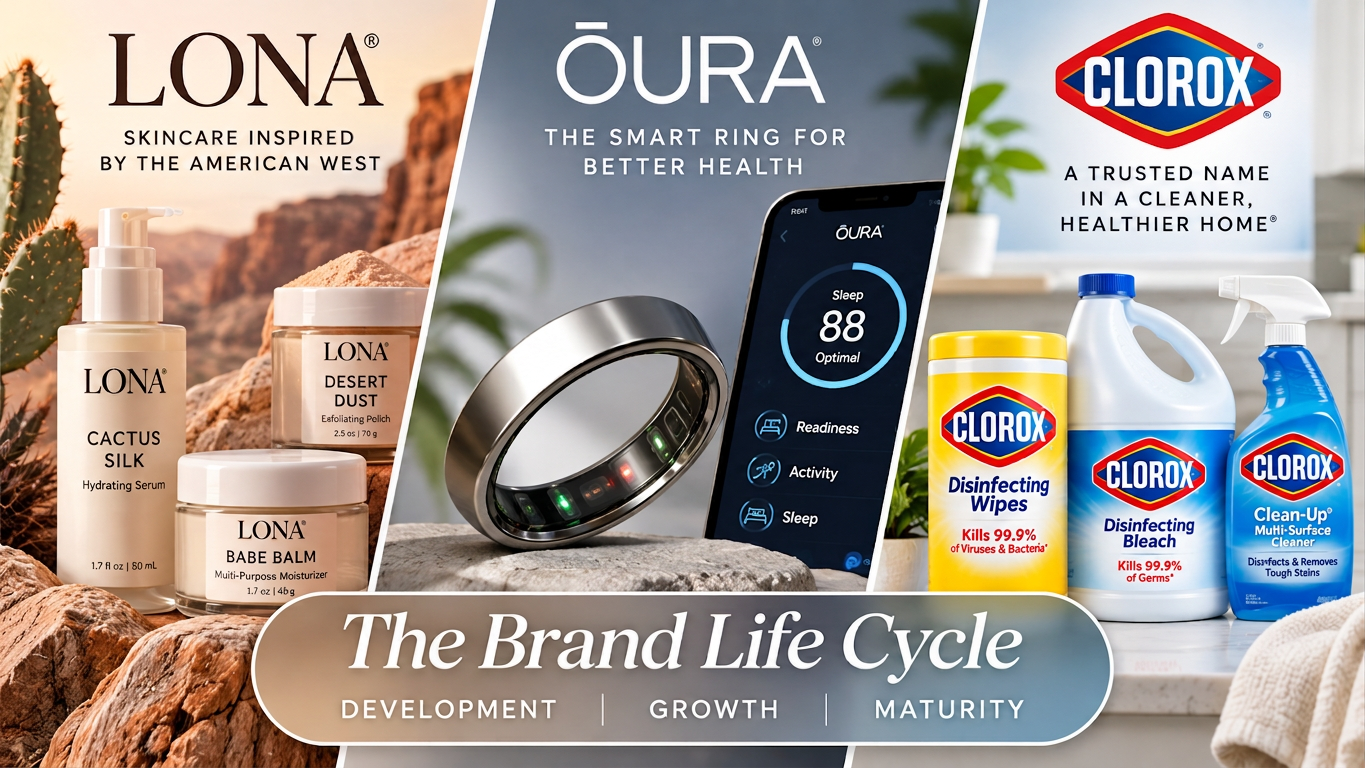
However, the way companies apply these strategies depends on their stage in the brand life cycle. Wheeler and Meyerson (2024) emphasize the importance of developing a recognizable brand identity that communicates value and differentiates a company from competitors. Let’s explore how three brands, LONA, OURA, and Clorox, apply the marketing mix at different stages of development.
Brand Development: LONA Skincare
One of the more interesting newcomers to the beauty industry is LONA, a skincare brand launched in 2026. Its identity draws inspiration from the American West, emphasizing simplicity, resilience, and practical skincare solutions (LONA, 2026).
What makes LONA interesting is its approach to building recognition in an already competitive beauty market.
How LONA applies the 4 Ps:
- Product: LONA offers a focused skincare collection, including Cactus Silk, Desert Dust, and Babe Balm, emphasizing simplified skincare routines.
- Price: Products range from approximately $28 to $48, positioning the brand within a more premium skincare category.
- Place: Its online storefront provides direct access to products while allowing the company to communicate its identity consistently.
- Promotion: Regional storytelling, distinctive product names, and introductory offers help establish awareness and encourage trial purchases.
LONA’s strongest opportunity is creating a meaningful connection with consumers who appreciate simplicity and authenticity. Its regional inspiration also provides a distinctive identity beyond the typical promises of the beauty industry.
At this stage, the goal is not necessarily widespread recognition but establishing a foundation of trust, positive consumer perceptions, and brand equity (Wheeler & Meyerson, 2024).
Brand Growth: OURA
Technology continues to reshape how consumers approach personal wellness, and OURA has positioned itself within this growing market. Its smart rings provide insights into sleep, activity, and other wellness measurements.
Unlike traditional fitness trackers, OURA combines technology with jewelry-inspired design, creating a product that appeals to both functionality and personal style.
How OURA applies the 4 Ps:
- Product: Smart rings and a companion application provide personalized wellness insights.
- Price: Premium device pricing and a membership model support its technology-focused positioning.
- Place: Direct online sales and retail partnerships make its products accessible through multiple channels.
- Promotion: Wellness messaging, partnerships, and product innovation communicate the benefits of understanding personal health.
OURA’s growth is supported by measurable expansion. In June 2024, the company announced that it had surpassed 2.5 million rings sold, while its membership base had more than tripled since 2021 (OURA, 2024).
These results demonstrate how differentiation and distribution can contribute to brand growth. By combining useful technology with lifestyle appeal, OURA strengthens consumer perceptions of innovation, convenience, and personal value.
Brand Maturity: Clorox
Some brands become so familiar that consumers automatically associate them with a particular product category. Clorox is a great example.
Established in 1913, Clorox has developed a recognizable identity around cleaning, reliability, and household care (The Clorox Company, n.d.).
However, maintaining that recognition requires more than simply having a familiar name.
How Clorox applies the 4 Ps:
- Product: An extensive selection of bleach, disinfecting wipes, sprays, and cleaning products addresses different household needs.
- Price: Coupons and promotional deals encourage purchases while helping the brand remain competitive.
- Place: Widespread retail distribution and online availability make products convenient to purchase.
- Promotion: Advertising, seasonal campaigns, and partnerships reinforce the brand’s association with household cleanliness.
One creative example is Clorox’s 2025 holiday campaign, which offered shoppers a complimentary cleaning service and product bundle. This promotion connected the brand with the emotional value of having more time to enjoy the holidays (The Clorox Company, 2025).
Rather than relying exclusively on product performance, Clorox uses convenience, familiarity, and emotional appeal to reinforce its relevance.
Final Thoughts
Although LONA, OURA, and Clorox operate in different industries and represent different life-cycle stages, they share one objective: creating value that consumers recognize and remember.
LONA is establishing its identity, OURA is expanding its reach, and Clorox is reinforcing an established reputation. Their strategies illustrate how the marketing mix can evolve as brands develop, grow, and mature.
Ultimately, successful branding is not just about attracting customers. It is about giving them a reason to choose the brand again.
References
Clorox. (n.d.). Coupons & deals. https://www.clorox.com/coupons-deals/
Clorox. (n.d.). Products. https://www.clorox.com/products/
LONA. (2026). Our story. https://lonabeauty.com/pages/our-story
LONA. (n.d.). The lineup. https://lonabeauty.com/collections/the-lineup
Oura. (n.d.). Oura store. https://ouraring.com/store
ŌURA. (2024, June 14). ŌURA helping millions of people improve their health, surpasses 2.5 million rings sold. Business Wire. https://www.businesswire.com/news/home/20240614157633/en/URA-Helping-Millions-of-People-Improve-Their-Health-Surpasses-2.5-Million-Rings-Sold
The Clorox Company. (n.d.). Our story. https://www.thecloroxcompany.com/company/our-story/
The Clorox Company. (2025, November 12). Clorox launches free holiday gift of clean: Complimentary in-home cleaning service and essential product bundle for shoppers. https://investors.thecloroxcompany.com/news/news-details/2025/Clorox-Launches-Free-Holiday-Gift-of-Clean-Complimentary-In-Home-Cleaning-Service-and-Essential-Product-Bundle-for-Shoppers/default.aspx
Wheeler, A., & Meyerson, R. (2024). Designing brand identity: A comprehensive guide to the world of brands and branding (6th ed.). Wiley.
Generative AI was used to assist with images, design, and content alignment.


Leave a Reply